Poverty can be deemed as the state of one who lacks a certain amount of material possessions or money. It is also a condition of having little or no money, goods, or means of support; condition of being poor (poverty.com).
As a child growing up I remember having a friend whose family could barely afford to provide for their children's needs. Often times I could remember her coming to school without getting anything to eat. It was so heart rending at times to see her going through so much pain. As her friend we tried to help her by giving her some of our lunch to eat but that was not sufficient at all because at the end of the day she would be going home not sure if dinner was prepared for her. After a period of time my teacher started to assist her and her family with the little she had and I can recall my friend saying that she felt much better and has less pain in her stomach because she was now able to get even a cup of tea with some crackers to eat before going to bed at nights. She was also put on the breakfast feeding program that the school implemented to assist children who had nothing to eat in the mornings.
About 25,000 people die every day of hunger or hunger-related causes, according to the United Nations. This is one person every three and a half seconds, as you can see on this display. Unfortunately, it is children who die most often.
Yet there is plenty of food in the world for everyone. The problem is that hungry people are trapped in severe poverty. They lack the money to buy enough food to nourish themselves. Being constantly malnourished, they become weaker and often sick. This makes them increasingly less able to work, which then makes them even poorer and hungrier. This downward spiral often continues until death for them and their families.
There are effective programs to break this spiral. For adults, there are “food for work” programs where the adults are paid with food to build schools, dig wells, make roads, and so on. This both nourishes them and builds infrastructure to end the poverty. For children, there are “food for education” programs where the children are provided with food when they attend school. Their education will help them to escape from hunger and global poverty.
Retrieved on March29,2013 from Hunger and World Poverty Sources: United Nations World Food Program (WFP), Oxfam, UNICEF.
Poverty in Europe
The European Commission has warned that eurozone countries are drifting
apart: An ever-declining south is facing a relatively stable north.
Governments are unable to protect household incomes.
Europe is paying a high price for the ongoing economic crisis.
Unemployment has risen to new highs and for those without a job, it is
becoming increasingly difficult to find a new one. Ever more people are
threatened with poverty.These are some of the findings of a report published on Tuesday (08.01.2012) by the European Commission's office for Employment, Social Affairs and Inclusion headed by Laszlo Andor. Andor, in a press conference on the report, stated that "household incomes have declined and the risk of poverty or exclusion is constantly growing."
Yet not everyone has been equally affected. Young adults, unemployed women and single mothers are especially at risk of sliding into chronic poverty, Andor said.
When the crisis began, the Commission and EU member states had promised that the social system would absorb some of the shock and have a stabilizing effect. However, with sinking tax revenues and rising welfare payments, many countries simply lacked the financial leeway to protect household incomes from the results of the crisis, Andor said.
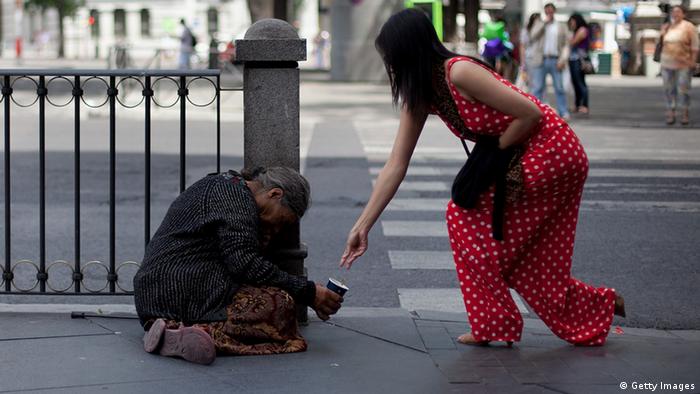 Limits to the welfare state? Poverty in Spain
To simply discuss European averages, does not get to the root of the problem - perhaps most disturbing is how the EU, and especially the eurozone, is splitting into a relatively stable north and an ever-declining south.
Take unemployment, for example. According to current figures from the European statistical authority Eurostat, Austria is experiencing unemployment at a rate of about 4.5 percent - compared to 26.6 percent in Spain, Europe's jobless frontrunner.
The situation looks even bleaker for youth in Spain and Greece, where more than every one in two lacks work - illustrating the gulf between individual nations.
According to Andor, the problem lies in poor or lacking qualifications. "In some countries, notably in the Southern part of Europe, the match between skills and jobs is bad and/or has worsened," Andor stated at a press conference about the report's findings.
Many states are experiencing a vicious cycle of unemployment, shrinking tax revenues, sinking investment, and recession leading to ever more unemployment. Other stressors that affect the development of children are the incarceration of children, alcoholism in the family. The government is working assiduously to compact the problems faced for the enrichment of their nation's children.
Retrieved on March 29,2013 from http://www.dw.de/poverty-is-on-the-rise-in-europe/a-16507641

Hello Latoya,
ReplyDeleteYour post is relevant to many here in the states even today. There are so many children who go hungry in our cities today, despite the fact that many times these children's family are receiving assistant from the government. Other times the parents of many children are battling drug addiction and use what little money is given to them from the government assistant to buy drugs. This is occuring even in Florida, for example the school where I work has a program where children are given a bagback full of food to take home every Friday. This is a Title I school, which means that more than 50 percent of the children already receive either free or reduced breakfast and lunch. There also exists those who are living on limited incomes with larger families, with no additional help or resources. Yes, poverty is an issue that many in the entire world has experienced at one time or the other. Thanks for your post.
Best Regards,
Magda.